Smart Manufacturing Technologies Every Industry Should Adopt
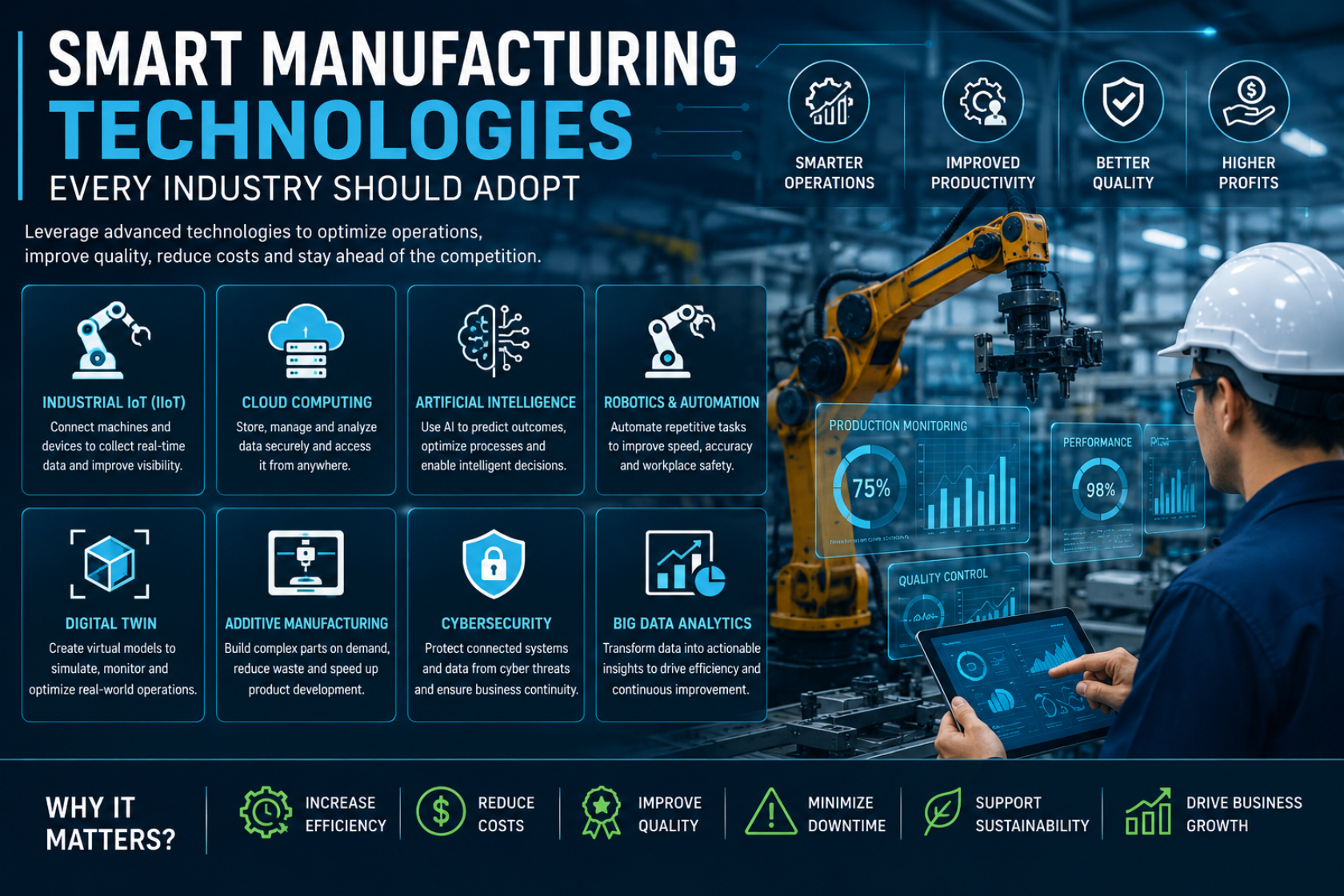
The manufacturing industry is undergoing a major transformation driven by automation, connectivity, and data-driven decision-making. Traditional production methods are rapidly evolving into smart manufacturing systems that improve efficiency, reduce operational costs, and enhance product quality. Whether you’re operating in automotive, pharmaceuticals, electronics, food processing, or heavy engineering, adopting smart manufacturing technologies is no longer optional—it’s essential for staying competitive.
Smart manufacturing integrates advanced technologies such as Industrial Internet of Things (IIoT), Artificial Intelligence (AI), robotics, cloud computing, and data analytics to create intelligent production environments. These technologies enable manufacturers to optimize operations, minimize downtime, and respond quickly to changing market demands.
In this blog, we’ll explore the key smart manufacturing technologies every industry should adopt to improve productivity and achieve long-term business success.
1. Industrial Internet of Things (IIoT)
The Industrial Internet of Things (IIoT) forms the foundation of smart manufacturing. IIoT connects machines, sensors, equipment, and production systems through a secure network, allowing real-time data collection and communication.
Benefits of IIoT
- Real-time equipment monitoring
- Predictive maintenance
- Improved production visibility
- Reduced machine downtime
- Better energy management
By collecting operational data continuously, manufacturers can identify inefficiencies before they become costly problems.
2. Artificial Intelligence (AI) and Machine Learning
Artificial Intelligence is revolutionizing manufacturing by enabling machines to learn from historical data and make intelligent decisions.
Applications of AI in Manufacturing
- Predictive maintenance
- Quality inspection using computer vision
- Production planning
- Demand forecasting
- Inventory optimization
Machine learning algorithms analyze production data to detect anomalies, predict equipment failures, and improve manufacturing efficiency.
3. Factory Automation Systems
Factory automation replaces manual processes with automated machines and intelligent control systems.
Modern factory automation includes:
- PLC (Programmable Logic Controller)
- SCADA Systems
- DCS (Distributed Control Systems)
- HMI (Human Machine Interface)
Automation increases production speed while reducing human error, ensuring consistent product quality across manufacturing lines.
Key Advantages
- Faster production cycles
- Improved workplace safety
- Lower labor costs
- Higher production accuracy
- Better process control
4. Industrial Robotics
Industrial robots have become an integral part of smart manufacturing facilities.
Robots perform repetitive and high-precision tasks such as:
- Assembly
- Welding
- Material handling
- Packaging
- Painting
- Inspection
Collaborative robots (Cobots) can safely work alongside human operators, increasing productivity without replacing skilled workers entirely.
5. Predictive Maintenance
Traditional maintenance approaches often result in unexpected equipment failures or unnecessary servicing.
Predictive maintenance uses:
- Sensors
- AI algorithms
- Real-time machine monitoring
- Data analytics
This technology predicts equipment failures before they occur, allowing maintenance teams to schedule repairs at the optimal time.
Benefits
- Reduced downtime
- Lower maintenance costs
- Extended equipment lifespan
- Improved production reliability
6. Digital Twin Technology
A Digital Twin is a virtual replica of a physical machine, production line, or manufacturing facility.
Manufacturers use digital twins to:
- Simulate production processes
- Test operational changes
- Monitor equipment performance
- Optimize workflows
- Improve product design
This technology enables businesses to identify potential issues without interrupting actual production.
7. Cloud Computing
Cloud-based manufacturing platforms provide centralized access to production data from anywhere.
Cloud technology supports:
- Remote monitoring
- Multi-plant management
- Secure data storage
- Real-time collaboration
- Automated reporting
Manufacturers can access dashboards, machine performance reports, and operational insights using cloud-connected systems.
8. Advanced Data Analytics
Manufacturing generates massive amounts of operational data every day. Advanced analytics transforms this data into actionable insights.
Manufacturers can analyze:
- Production efficiency
- Equipment utilization
- Energy consumption
- Product quality
- Downtime trends
Data-driven decision-making helps organizations improve productivity while reducing operational costs.
9. Smart Sensors
Smart sensors continuously monitor machine health and production parameters.
Common sensor applications include:
- Temperature monitoring
- Pressure measurement
- Vibration analysis
- Humidity detection
- Energy monitoring
These sensors provide real-time alerts whenever equipment operates outside acceptable limits.
10. Manufacturing Execution Systems (MES)
A Manufacturing Execution System (MES) bridges the gap between enterprise planning systems and shop floor operations.
MES provides:
- Production scheduling
- Work order management
- Quality tracking
- Material traceability
- Performance reporting
This ensures complete visibility across manufacturing operations and supports continuous improvement initiatives.
11. Automated Quality Inspection
Quality control has evolved with AI-powered vision systems.
Automated inspection systems can:
- Detect defects instantly
- Measure dimensions accurately
- Verify product consistency
- Reduce human inspection errors
This improves product quality while reducing production waste.
12. Cybersecurity for Smart Manufacturing
As factories become more connected, cybersecurity becomes increasingly important.
Manufacturers should implement:
- Secure industrial networks
- Multi-factor authentication
- Regular software updates
- Data encryption
- Network monitoring
Protecting industrial control systems ensures uninterrupted operations and safeguards sensitive production data.
Benefits of Smart Manufacturing Technologies
Organizations adopting smart manufacturing experience significant operational improvements, including:
- Increased production efficiency
- Lower operational costs
- Reduced machine downtime
- Higher product quality
- Faster decision-making
- Improved workplace safety
- Better resource utilization
- Greater customer satisfaction
- Sustainable manufacturing practices
- Enhanced global competitiveness
Industries Benefiting from Smart Manufacturing
Smart manufacturing technologies are transforming a wide range of industries, including:
- Automotive Manufacturing
- Electronics Manufacturing
- Pharmaceutical Industry
- Food & Beverage Processing
- Chemical Manufacturing
- Textile Industry
- Heavy Engineering
- Packaging Industry
- Oil & Gas
- Aerospace Manufacturing
Regardless of industry size, implementing intelligent manufacturing solutions enables businesses to remain competitive in an increasingly digital economy.
Conclusion
The future of manufacturing lies in intelligent, connected, and automated production environments. Technologies such as IIoT, Artificial Intelligence, industrial robotics, predictive maintenance, digital twins, cloud computing, and advanced analytics are no longer emerging trends—they are becoming industry standards.
Businesses that invest in Smart Manufacturing Technologies, Industrial Automation Solutions, Factory Automation, and Smart Manufacturing Systems gain greater operational efficiency, improved product quality, lower costs, and enhanced flexibility. As industries continue to embrace digital transformation, adopting these technologies will be essential for sustainable growth, innovation, and long-term success in the global manufacturing landscape.

 Custom Electronics
 Digital Transformation
 Test Measurement & Control
 Our Products
 New Product Development
 Build To Print
 Build-to-Spec Custom Electronics
 Learn More